
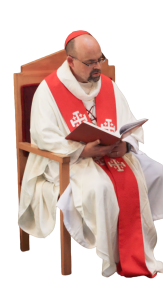
 Companions of the Sacred Flame,
I weave a silence onto my lips.
I weave a silence into my mind.
I weave a silence within my heart.
I close my ears to distractions.
I close my eyes to attractions.
I close my heart to temptations.
Calm me, O Lord, as you stilled the storm.
Still me, O Lord, keep me from harm.
Let all tumult within me cease.
Enfold me, Lord, in your peace.
– Fr. David Adam
It is hard to believe we’re almost at the end of the year. I hope for each of you it has been a good one or has had high points of joy which have kindled some warmth against the times that have been less good.
During Liturgy this past month, I discussed the practice of Hesychasm, Stillness, in the Eastern Christian tradition – and as context, mentioned differing approaches to posture, breathing and sensory input in contemplative practice – there are practices in which your eyes remain open, and some in which folks are more likely to close them.
One advantage to closing them during practice is that it reduces immediately the amount of sensory data that one takes in. It doesn’t decrease focus, it shifts it – with your physical eyes closed, one’s attention can be opened to all that is going on with one’s inner realm.
The same can be true of everyday external life – the last thing a Gnostic wants to do is to not be aware, but a recognition of our own boundaries, limitations and priorities, is a vital part of one’s spiritual journey.
Rather than be inundated, we choose and engage times in which we shift the focus of where we look, and what we hear. Sometimes saying no to the world, is saying yes to oneself or those we care for. Be mindful to make your approach in these moments one not of ‘never’ to the world but rather a ‘not yet’ or a ‘not now’.
The same practice of shifting attention can not only be brought to what we take in, but also what we say and do.
I am fond of the questions asked in the stories and cases (koans) in the Zen Buddhist tradition – and in Case 70 of the Hekiganroku, a question is asked:
“With your mouth and lips closed, how would you say it?”
Our hours, days and years are full of words – some useful, many not, and sometimes it is a valuable exercise that when we need to engage with the world, with another or even with ourselves – to approach as if we are deprived of language – and engage how might we communicate with the moment in front of us in another way.
My take on the answer to the koan is that the Ineffable can only be addressed Ineffably – God’s first language is silence, everything else is poor translation, says the late Fr. Thomas Keating – but I think it also has a deep import for our own interaction with the world and each other- deprived of language, we might communicate care with a hug, friendship with a handshake, concern with a glance and shock with a covering hand, to name a few examples.
When and to what, might we as the poet-priest says, close our hearts?
I would suggest that as a spiritual rule, closing our hearts completely is a grave mistake – but there are moments where limiting both our intake and output of bitterness, cynicism, anger and their other myriad cousins, is vital.
Tradition it is said is not the worship of ashes but the preservation of fire – and in the seasons of our life when things get cold – we need not get cold with it, because we have kept the sacred flame burning in our being by understanding and choosing when and how much of the wind of the world to let in, in such a way as to fan but not extinguish that flame.
Speak without words, hear without sound, set a boundary without bars.
Recent Comments